
Compare blasting method, machine fit, and abrasive choice faster.
How to Calculate Dust Collector CFM for a Blast Room (With Formula)
Poor visibility inside a blast room can slow down production, increase abrasive consumption, and make it difficult for operators to inspect blasted surfaces. One common reason is an undersized dust collector system.
But how much airflow does a blast room actually need? Should you calculate it using room volume, air changes per hour, or cross-sectional velocity?
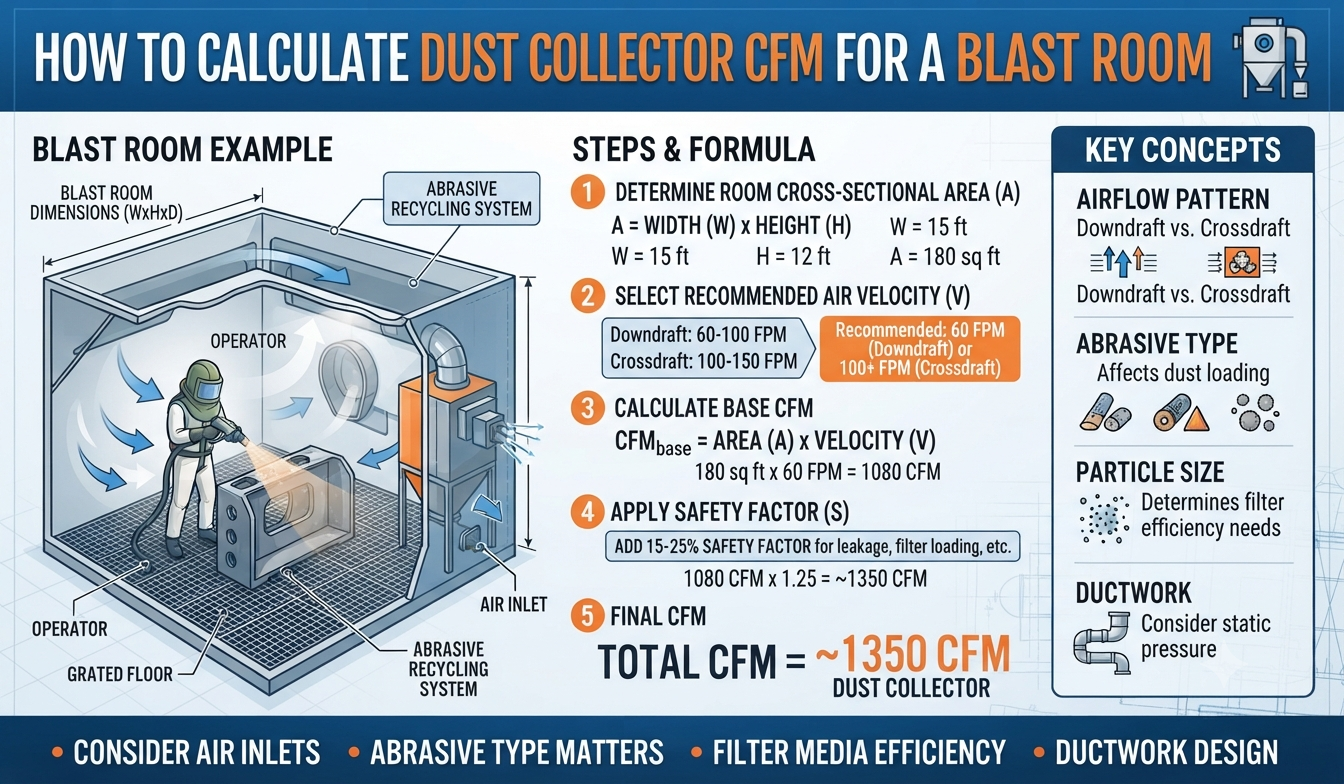
Understanding the blast room dust collector CFM calculation helps engineers estimate the required airflow before selecting a dust collector. This guide explains the formulas, a practical calculation example, and important factors to consider when sizing an industrial blast room dust collection system.
What Is CFM in a Blast Room Dust Collector?
CFM stands for cubic feet per minute. It measures the volume of air a dust collector can move in one minute.
In an abrasive blasting room, the dust collector removes airborne dust generated during blasting and helps maintain visibility inside the enclosure.
The required CFM depends on several factors:
-
Blast room length, width, and height
-
Required airflow and dust removal rate
-
Number of blasting operators
-
Abrasive type (such as copper slag) and blasting intensity
-
Dust collector filter resistance and ductwork
-
Required visibility and operating conditions
A correctly sized dust collector helps maintain suitable airflow and supports safer, more efficient blasting operations.
Calculate CFM Using Air Changes per Hour (ACH)
Air changes per hour represent how many times the room's air volume is theoretically replaced in one hour.
This method provides a simple preliminary estimate based on the room's dimensions.
Formula
Required CFM = Room Volume × ACH ÷ 60
Where:
-
Room volume is measured in cubic feet.
-
ACH is the selected air changes per hour.
-
60 converts hourly airflow into minutes.
Example Calculation
Suppose an industrial blast room has the following dimensions:
|
Parameter |
Measurement |
|
Length |
30 ft |
|
Width |
20 ft |
|
Height |
15 ft |
|
Selected ACH |
60 |
Step 1: Calculate room volume
Room Volume = Length × Width × Height
30 × 20 × 15 = 9,000 cubic feet
Step 2: Calculate required airflow
CFM = 9,000 × 60 ÷ 60
Estimated airflow = 9,000 CFM
This means the room requires an airflow rate of 9,000 cubic feet per minute to achieve the selected 60 ACH.
However, ACH is only a preliminary sizing method. The selected ACH must be appropriate for the application, and actual dust removal requirements may demand a different airflow rate.
Calculate CFM Using Cross-Sectional Velocity
Cross-sectional velocity is another method used to estimate airflow through a blast room.
This approach considers the room's cross-sectional area and the desired airflow velocity.
Formula
CFM = Cross-sectional Area × Air Velocity × 60
Where:
-
Cross sectional area is measured in square feet.
-
Air velocity is measured in feet per second (FPM is feet per minute, so use consistent units).
-
60 converts cubic feet per second into cubic feet per minute.
For clarity, when velocity is expressed in feet per minute, use:
CFM = Cross-sectional Area × Air Velocity (FPM)
Example Calculation
Assume a blast room has:
-
Width: 20 ft
-
Height: 15 ft
-
Selected airflow velocity: 50 FPM
Step 1: Calculate cross-sectional area
20 × 15 = 300 square feet
Step 2: Calculate airflow
300 × 50 = 15,000 CFM
The estimated airflow is 15,000 CFM.
The selected velocity is an example for calculation, not a universal design requirement. Engineers must determine the appropriate airflow direction and velocity based on the room configuration, blasting process, and applicable safety requirements.
Which CFM Calculation Method Should You Use?
Both methods provide useful information, but they serve different purposes.
|
Calculation Method |
Best Use |
|
ACH method |
Preliminary airflow estimate based on room volume |
|
Cross-sectional velocity |
Estimating airflow through a defined room section |
For a practical design, engineers can calculate both values and compare them.
However, the final dust collector capacity should not be selected simply by choosing the higher number. The room's airflow pattern, dust generation rate, extraction points, and system resistance must also be evaluated.
What Happens When Dust Collector CFM Is Too Low?
An undersized dust collector may cause several operational problems.
Poor Visibility
Insufficient airflow can allow dust to remain suspended inside the blast room for longer periods. Operators may struggle to see the component surface clearly, making it difficult to monitor blasting progress.
Operator Safety Concerns
Poor dust extraction can increase airborne dust exposure. Depending on the abrasive and coating being removed, this dust may contain hazardous particles.
Appropriate respiratory protection, ventilation, and dust collection are essential, whether the work is done in a blast room or with a portable sand blasting machine on site. A dust collector alone does not replace the required operator PPE or exposure controls.
Reduced Production Efficiency
When visibility is poor, operators may need to pause blasting or repeat surface preparation. This can increase processing time and operating expenses.
Increased Equipment Contamination
Dust can accumulate on equipment, lighting, and other surfaces when extraction is inadequate. Regular inspection and proper dust collection help control this issue.
Important Factors Before Selecting a Dust Collector
A calculated CFM value is only one part of dust collector selection, and it should never be compared on dust collector price alone.
Engineers should also consider:
-
Filter type and filtration efficiency
-
Duct diameter and total duct length
-
Pressure losses across filters and ductwork
-
Abrasive type and dust generation rate
-
Dust collector fan performance at the required static pressure
-
Airflow distribution inside the blast room
The dust collector must deliver the required airflow under actual operating conditions, not just at its maximum free-air rating.
Conclusion
Calculating the correct blast room dust collector CFM is essential for maintaining visibility, supporting operator safety, and improving industrial blasting efficiency.
The ACH method provides a simple preliminary estimate, while cross sectional velocity helps evaluate airflow through the room.
For accurate equipment selection, both calculations should be supported by an engineering assessment of dust generation, airflow distribution, filtration, and system pressure losses.
At AIROSHOT, industrial buyers can explore dust collection and blast room equipment solutions according to their application requirements.
Planning a new blast room or upgrading your existing dust collection system? Contact airoshotblast to discuss your room dimensions, blasting process, and required airflow. A properly designed dust collection system can help support safer and more efficient surface preparation operations.
Need a quote or brochure after reading this article?
Move directly from information to enquiry if you want machine details, pricing support, or help choosing the right product.